
Procedures
Dental Implants





Dental Implants in Miami Beach and Aventura, FL.
Usually, when you lose a tooth, it is best for your oral health to have it replaced. Missing teeth can affect your “bite” as well as your ability to speak and chew, and your appearance. But did you know that tooth loss can increase the burden on your remaining teeth? This can cause muscle pain in your jaws, which can lead to headaches.
The good news is that, most of the time, replacing a missing tooth is not an emergency. You have time to consider the best replacement option for you. Below we will discuss all the different options available including: dental implants, dental bridge, and removable dental appliances.

What Are Dental implants?
Dental implants are a permanent tooth replacement solution designed to restore both the appearance and function of missing teeth. They consist of a small, biocompatible titanium post that is surgically placed into the jawbone, where it acts as an artificial tooth root. Over time, the implant fuses with the bone through a natural process called osseointegration, creating a strong and stable foundation.
Once the implant has healed, it is topped with a custom dental crown, bridge, or denture that looks, feels, and functions like a natural tooth. Because implants replace both the root and the visible portion of the tooth, they provide superior stability, comfort, and longevity compared to traditional tooth replacement options.
Dental implants are commonly used to replace:
A single missing tooth
Multiple missing teeth
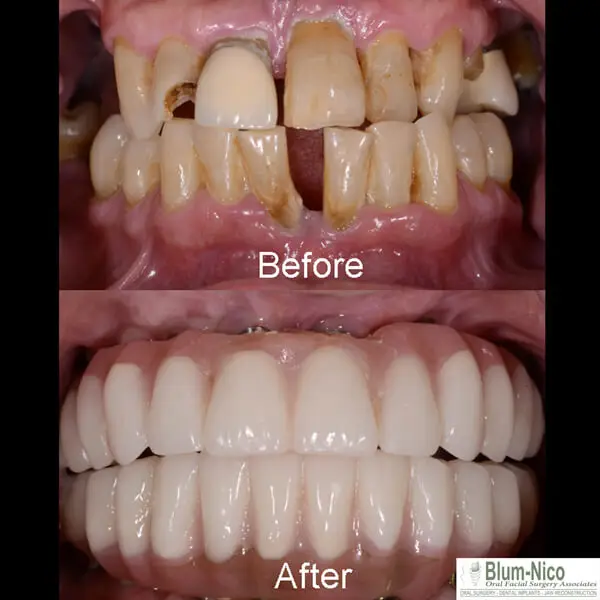
An entire upper or lower arch of teeth
Unlike removable dentures, dental implants are fixed in place and help preserve jawbone structure, prevent facial sagging, and maintain long-term oral health. With proper care, dental implants can last for many years—often decades—making them one of the most reliable solutions in modern dentistry.
Alternatives to Dental implants
- A “dental flipper” is a removable plastic tooth that is usually a temporary solution. The downside of a dental flipper is that it is fragile and can easily break.
- A cast partial denture is another removable restoration. The difference is that it is precision cast in metal for longer a longer life. Wire clips help hold it in place. The downside of a cast partial denture is that prolonged use of a partial denture can actually loosen the teeth that are used as anchorage.
- A fixed dental bridge is cemented into place using crowns or “caps” on the teeth adjacent to the open space for support. Crown placement usually requires removing or reducing the outer layer of the tooth. In some cases, a “Maryland” bridge, a fixed bridge that does not need crowns, is glued onto the back of the teeth adjacent to the space so that minimal tooth structure is removed.
- Full dentures or “plates” are the traditional solution for people who have lost all their teeth in one or both jaws. The success of a full denture depends upon the individual’s jaw size and shape, his or her oral habits, and his or her adaptability. Some people adapt well to full dentures, while others are not able to adapt. Dental implants can be used to provide support for the replacement of one tooth or all of an individual’s teeth. After years of research and clinical trials, we can now provide this option in addition to the traditional treatments just described. Implant-supported teeth can be cemented, screw-retained, or removable and can be made attractive, stable, and comfortable for almost any patient.
Are Dental Implants an Option for Me?
New advances in dental implant and bone grafting technologies have made it so that most people can have dental implants even if they have been told before that they are not good candidates for dental implants.
If you are considering dental implants, your mouth will be examined thoroughly and your dental and medical history will be reviewed to ensure that dental implants are appropriate for you. Dental x-rays and, frequently, panoramic (or complete) x-rays, or a 3-D scan of your jaws will be taken to evaluate your jawbone and to determine if it will accommodate dental implants.
There are many cases when teeth can be immediately replaced with implants.
Occasionally, more detailed information is required and can be provided by special x-rays. They will help determine if additional tests or procedures are needed to place your dental implants properly.
How are Dental Implants Placed?
For your comfort we can perform any of our surgical procedures under IV sedation or “twilight sleep.”
Usually, the office procedure to place a dental implant takes about an hour for one implant and no more than two or three hours for multiple implants. The placement process consists of the following steps:
If indicated, you will be given medication such as antibiotics prior to the surgery. You may be offered sedation with nitrous oxide (“laughing gas”) or intravenous medications. Then, a local anesthetic will be administered to numb the areas where the implants will be placed.
After you are comfortable, a small incision is made into the gum tissue, revealing the bone into which the implant will be placed.
Using special instruments, a socket is created carefully, avoiding damage to the bone.
The titanium implant is then inserted into the socket.
Finally, if necessary, sutures will be used.
After the implant is placed, the area will need to heal between six weeks to four months. How long your mouth will need to heal will be determined by a variety of factors. Follow-up care (one to four appointments) is usually needed to ensure that your mouth is healing well and to determine when you are ready for the restorative phase of your treatment.
In general, once your implants are placed, you can expect your treatment to be completed anywhere from two to 12 months.
Learn more about the advanced X-NAV technology for implant placement
Our office is the first oral surgery practice in South Florida to use this advanced 3D technology to place dental implants. The X-Guide system is designed to elevate the surgeon’s control and precision over the entire dental implant process, including planning and placement. This results in the ability to deliver a more precise, functional, and aesthetic outcome in dental implant surgeries.
It’s like a GPS for placing dental implants. The X-Guide™ system utilizes the surgeon’s plan to provide turn-by-turn guidance during live surgery, giving the ability to visualize precise anatomical landmarks and track movements of the handpiece during implant surgery for more exact implant placement.
Now immediate implant placement can be a reality for more patients. This is a big advantage, as more patients want their implant results to be functional and aesthetic, while minimizing complications and reducing time in the dental office. It is a great advance for patient treatment. Now patients can benefit from more accurate, faster, and more predictable implant placement and temporarization.
If you have any questions about our services, please contact us today at (305) 936-5974 (Aventura) or (305) 538-4556 (Miami Beach).
Dental Implant Frequently Asked Questions
Dental implant treatment often comes with many questions. Below you’ll find answers to the most common questions about dental implants, including candidacy, procedure steps, recovery, comfort, and long-term results. At Blum & Nico Oral Surgery Associates, our goal is to help you feel informed and confident as you explore dental implants as a safe, long-lasting solution for replacing missing teeth.
What are dental implants?
Who is a good candidate for dental implants?
How long does the dental implant process take?
Is the procedure painful?
How should I care for my dental implants?
How long do dental implants last?
What are the advantages of dental implants versus dentures or bridges?
Can dental implants replace multiple teeth?
What should I expect during recovery?
Get in touch
- Monday to Thursday 9AM - 5PM | Friday 7:30AM - 3PM
- Aventura: (305) 936-5974 | Miami: (305) 538-4556
- 2999 NE 191st St #607, Miami, FL 33180, EE.UU.
- Golden Medical Office Building 4308 Alto Rd #850, Miami Beach, FL 33140, EE.UU